
...and how to move to new keys
In this lesson we will learn how to play the Blues scale. There are a couple of different Blues scales in existence but we'll learn the one most commonly used for blues guitar. It is an alteration of the 5 tone minor Pentatonic scale which adds one note (called the blue note). This makes it a hexatonic scale meaning it has six tones.
The Blues scale compared to the Pentatonic.
If you haven't already done so, read my lesson on Pentatonic scales HERE. By adding just one note to the minor Pentatonic scale you get the Blues scale.
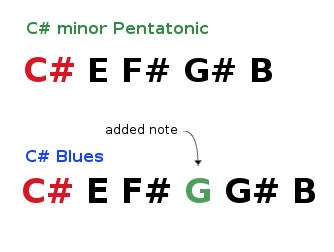
The C# Blues scale is also in the same position and has the same notes as an A Major scale minus the A and D and with added G (blue note).
Blues scale - 5 patterns to learn
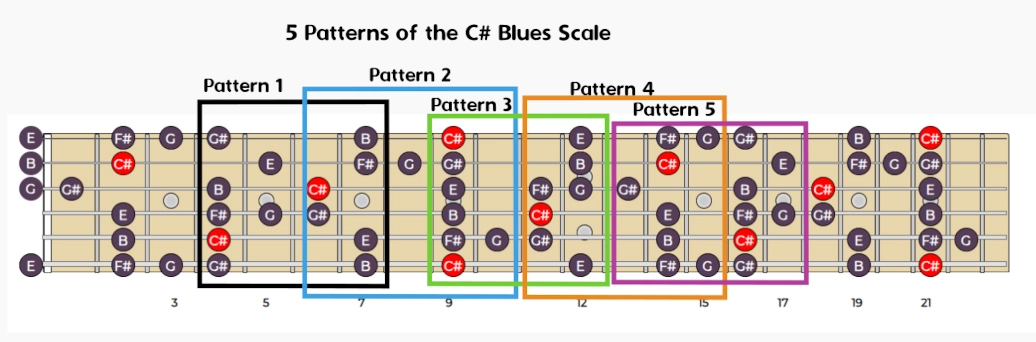
A helpful memorization visual of the 5 scale patterns so you can see how they overlap on the fretboard. Use these with the Tab below.
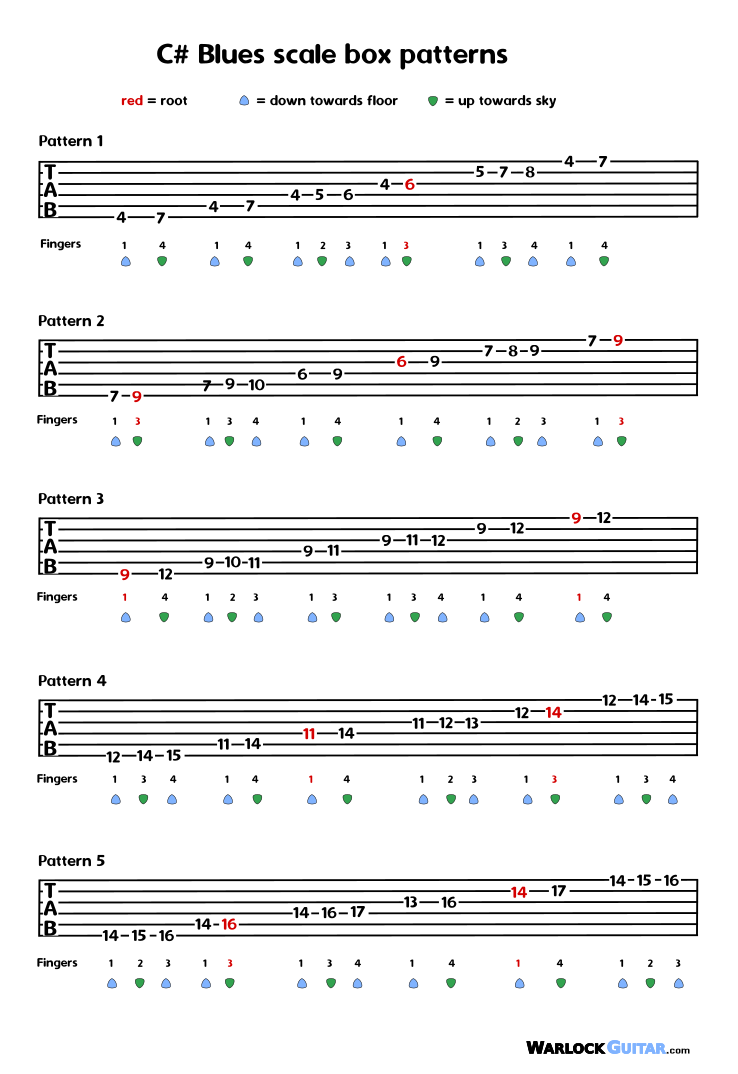
Blues scale guitar TAB
Use this guitar TAB below to learn the five patterns of the Blues scale at your own pace. Pay attention to the picking directions.
Notes on Memorization
* Memorize each of the five patterns individually before moving to the next. *. Notice where pattern 5 ends, pattern 1 repeats. Also right before pattern 1 begins, pattern 5 ends. * As you play the Blues scale patterns try to visualize how they each differ from the Pentatonic scale patterns.
Moving the scale to new keys
Moving to new keys is just as easy as sliding all five patterns as a whole to any new position on the fretboard. The new key name will be the same name as the notes in the positions of red C# dots in the box pattern diagaram. Again notice where Pattern 5 ends, pattern 1 repeats.
Summary
The Blues scale should be a fairly easy scale for you to add to your arsenal because of how similar it is to the Pentatonic scales. With just a little extra effort you should be able to easily have this scale committed to memory.
