
...tricks to help you escape the guitar scale box

In this lesson you will learn how to break out of the box and play through scale patterns on the guitar fretboard and how to know exactly where to play a scale in any key.
You may have heard other guitarists talking about their learning hitting a plateau because the seemed confined to the proverbial box and how they need to break out. The confined box feeling comes from learning how to play scales by using box pattern method to memorizing scales. This lesson will show you how to break out the box and learn to play all over the fretboard and know exactly what key you are in.
I'll do this by showing you a few seemingly magical licks that have some very unique tricks buried inside. These tricks will open your mind to a new way of thinking about how you navigate the guitar neck.
Learn the scale patterns first
Of course...in order to learn anything from this lesson, you must first have your guitar scales memorized using the the box pattern method. In the key of A Major the box patterns look like this:
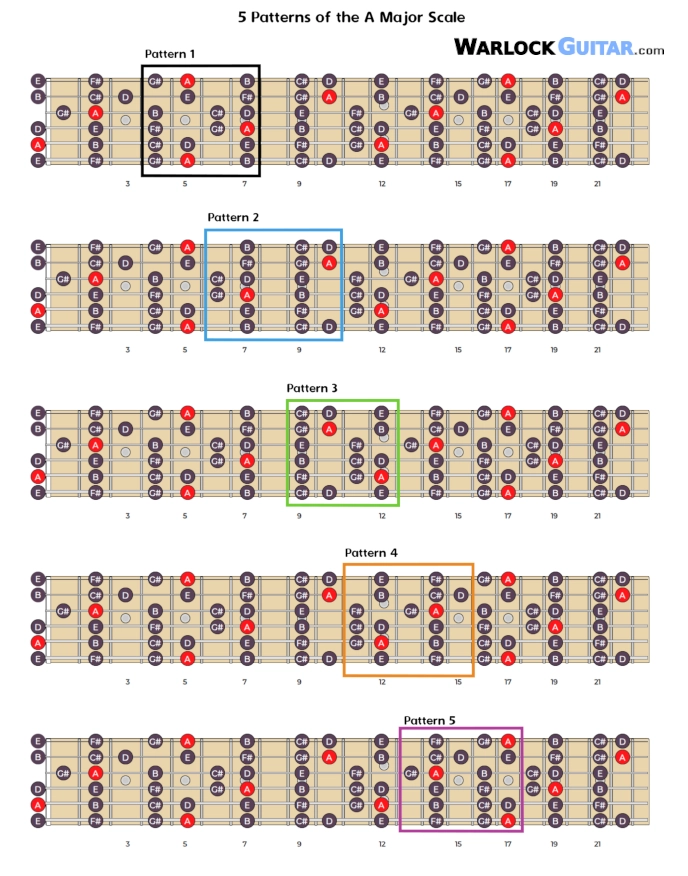
So if you still don't know what the "box" is... I have a lesson on how to memorize guitar scales all over the neck using the box pattern method. Make sure to read my previous lesson on Learning to memorize scales which covers that.
Tools of Navigation
As you can see it is pretty easy to learn the Major scale all over the guitar neck. But music is so much more than playing scales. Scales patterns are just tools of navigation. To really learn how to play guitar you need to learn how to play through scales (among other things like playing to chord changes and timing).
What you are going to learn next is another tool of navigation that will help you do many things like switch scales, switch keys (modulation) and really master the fretboard.
The MAP
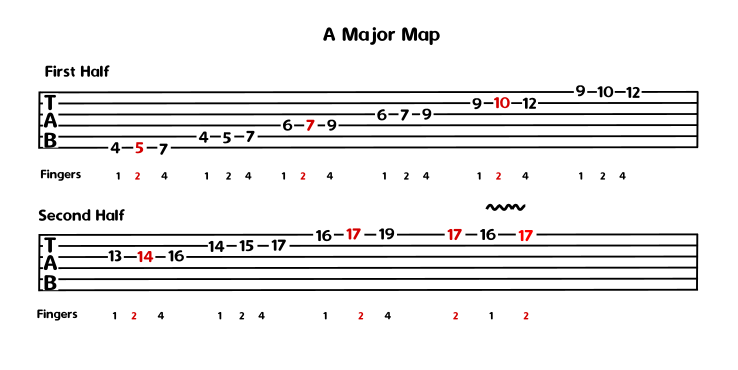
In our magical journey to break out of the box you will need a map. This Map is in the form of a lick which is probably the most important lick you can ever learn. It is a map of sorts that you can combine with the box method to help you "see" the fretboard more clearly as well as learn to play outside or "through" the boxes. There are also tricks you can do with it that help you see related scales and know what key you are in. This lick is in A Major. It plays all the notes of the scale but leaves out the 6th degree (the F#).
Practice playing each set of 3 notes on a string as triplets with alternate picking, first in 8th note triplets and work your way up in speed and accuracy to 32nd note triplets. Treat this lick as one big pattern. It is easy to do because you always use the same fingers for each set of three notes.
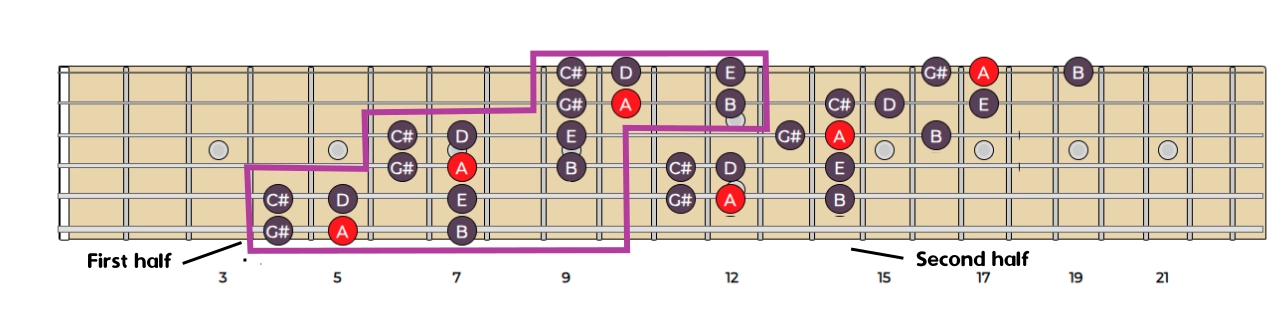
Here is a fretboard diagram of the notes used in the lick to help you visualize it.
The Trick of the Lick
There is a trick to this lick that you can use to know exactly where the root note of the scale is. Notice that the red fingers are always a "2" and that there is a corresponding red fret number. The red numbers are the root note of the scale which is an A. After memorizing this lick as one big pattern you will be able to slide it all over the fretboard to new keys. Wherever your second finger lands on a red "2" will always be the root note of whatever key you are in! Also, each group of six notes corresponds to a box pattern (the lick progresses through patterns 1-5) and a red "2" always occurs in the first set of 3 notes in a group of six. The only exception is the last six notes which is just where box pattern one repeats itself but on the first string (I added some vibrato there to make it sound better).
Now I am going to show you this lick once more but this time I will add back in some of the F#s I left out in order to show you another cool trick. This lick might not sound very good when you play it and it is not supposed to. It is just a here to demonstrate another trick.
Warlock Map Lick 2
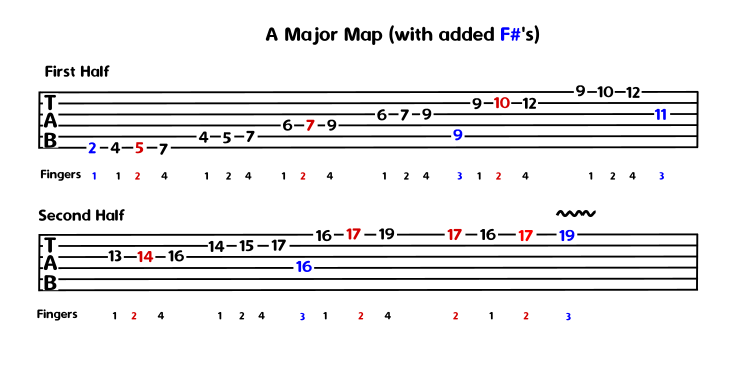
Another a diagram to help visualize the notes.
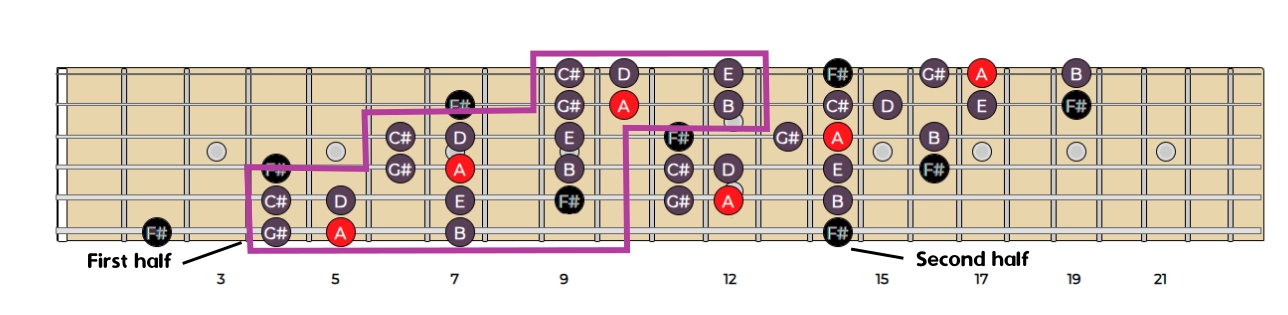
Notice where I put the F#s. Their fret numbers and finger numbers are in bold black. This is always the 6th degree of the scale which you should know from the scales section of the book that this is the root note of the Relative minor scale! Guess what? The note a half step behind each of those F#s is the raised 7th degree of the Harmonic minor scale (in the key of F# Harmonic minor that would be an E#). If you played all those E notes in the diagram a half step up as E# then this lick would be in F# Harmonic minor!
More tricks to this lick
Trick #1: Guess what happens if you don t play all the notes that your second finger falls on in the above lick with F#s added back in? In other words, what if you remove all the A and D's? If you do that you would playing a C# minor (or E Major) Pentatonic scale!
Trick #2: After doing Trick # 1 if you were to play the G note immediately after each of the F#s you would then be playing the C# Blues scale!
After learning this one big easy lick/pattern and all these tricks, I encourage you to practice moving around to new keys and to modify it and build other licks based off it. Mastering this lick and the above concepts will eventually lead you to total fretboard mastery. With practice you will know every note you are playing as you play it in any key you decide to play in.
Keep reading for further tricks to help you help you in your scale memorization journey...especially the section on 142531
Map Lick 3 - A Minor Perspective
Map licks 1 and 2 where from a Major scale perspective. Map lick 3 however is from a minor perspective, F# minor to be exact. F# minor is the relative minor of A Major which is what Map Licks 1 and 2 are in. This lick drops all the E notes. The main trick to this lick is that wherever your first finger lands (on the red numbers and dots) is the root of the scale. You can add back in the E note to get back the full minor scale. The lick's main function is to show you how to quickly play in any minor key. Just get good at moving the pattern around and knowing that the root of your new key will always be under your first finger!
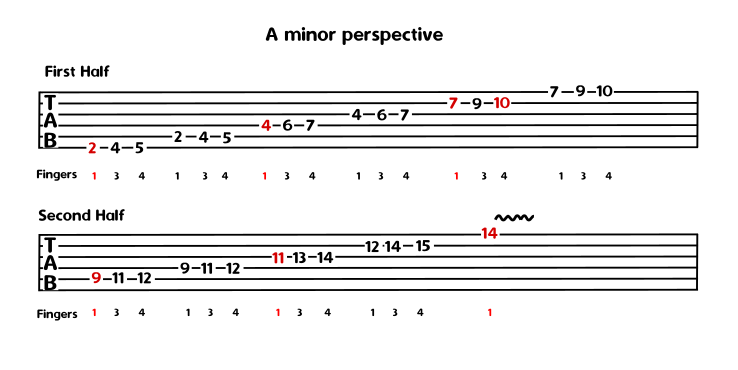
Below is a graphic to help you visualize the lick
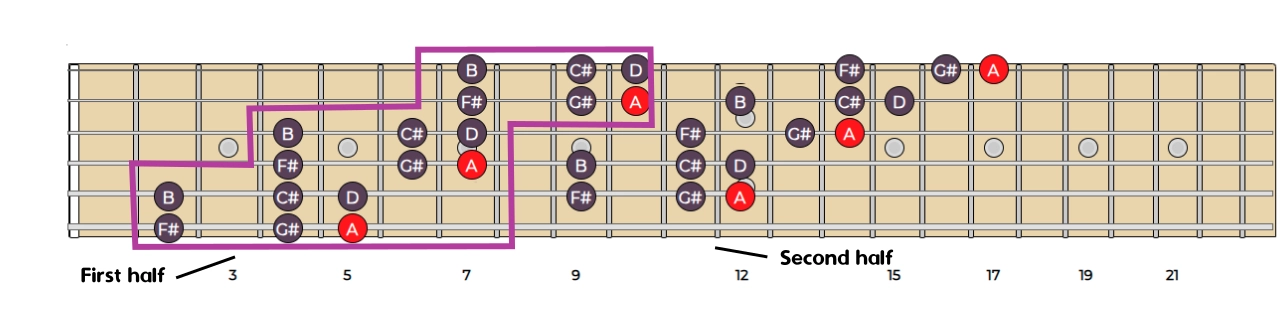
There is one last trick to this lick. Playing the E# note (not shown in the graphics you must find it) a half step below the F# will convert it into a Harmonic minor scale!
The 142531 Warlock Mnemonic
Now that you have been introduced to the Warlock map licks it is time to learn about 142531 (or 14 25 31 ) which is a mnemonic device that will help you be able to instantly play in any key. 142531 requires you to have the notes of the fretboard, the 5 patterns, and the map licks fully memorized in order to be used to its full potential.
What is 142531?
142531 is your roadmap that tells you where to start playing scale patterns in any key across the entire guitar fretboard.
How?
You know the guitar strings are numbered from lowest to highest as 654321. Well, if you assign the numbers 142531 to each of the string numbers you get:
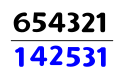
The Rules:
For any string, choose a note you want to use as the root note of a key to play in and put your second finger on it. The 142531 numbers are the numbers of the 5 box patterns.
Rules for each string:
If you pick a note on the 6th string to be the root of your key, the box pattern to start playing in is 1.
If you pick a note on the 5th string to be the root of your key, the box pattern to start playing in is 4.
If you pick a note on the 4th string to be the root of your key, the box pattern to start playing in is 2.
If you pick a note on the 3rd string to be the root of your key, the box pattern to start playing in is 5.
If you pick a note on the 2nd string to be the root of your key, the box pattern to start playing in is 3.
If you pick a note on the 1st string to be the root of your key, the box pattern to start playing in is 1.
When you follow the above examples and figure out what box pattern to start playing in, you can use the map lick mentioned earlier to play through the other patterns. This trick when mastered helps you instantly start playing a scale in any key. It is your roadmap telling you where you are!
A 142531 Example
An example for a key we have already been using, A Major, would go like this:
If you want to start playing on the 6th string you would put your second finger on the 5th or 17th fret to continue playing in pattern 1.
If you want to start playing on the 5th string you would put your second finger on the 12th fret or open string to continue playing in pattern 4.
If you want to start playing on the 4th string you would put your second finger on the 7th fret or 19th fret to continue playing in pattern 2.
If you want to start playing on the 3rd string you would put your second finger on the 2nd fret or 14th fret to continue playing in pattern 5.
If you want to start playing on the 2nd string you would put your second finger on the 10th fret or 22nd fret to continue playing in pattern 3.
If you want to start playing on the 1st string you would put your second finger on the 5th fret or 17th fret to continue playing in pattern 1 (same as 6th string).
As you can see if you know the notes of the fretboard and the map lick you can use 142531 to instantly know what key you are playing in. For any key, the only difference from the example above would be the fret numbers.
In summary
In this lesson you learned how to break out of the proverbial box and play through scale patterns on the guitar fretboard and how to know instantly where to play a scale in any key. Be sure to read the lesson as many times as it takes to build confindence.
